Today, installers, distributors, and project developers are increasingly asking:
What is the difference between Smart BMS and Traditional Battery Management?
Understanding this difference is essential for choosing reliable solar battery storage solutions.
What Is a Traditional Battery Management System?
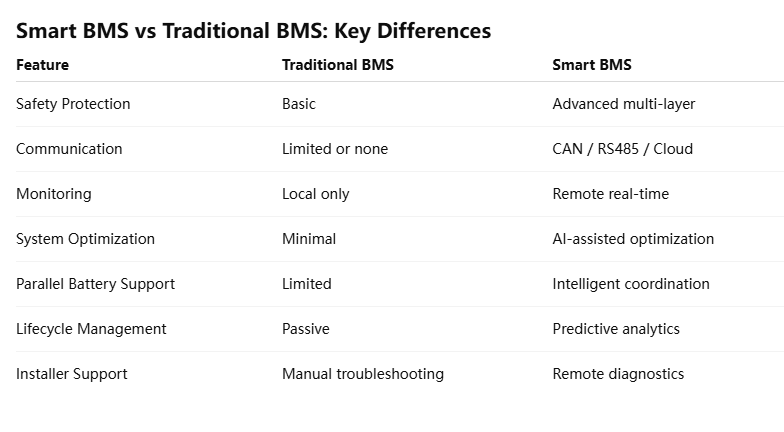
A traditional BMS focuses mainly on basic safety protection. It monitors battery parameters and prevents immediate risks.
Main Functions
Over-charge protection、Over-discharge protection、Short-circuit protection、Temperature cutoff、Basic voltage monitoring
These systems are typically used in:
Early generation lithium batteries、Small backup power systems、Low-cost storage solutions、Limitations
Traditional BMS often lacks:Real-time communication with inverters、Remote monitoring capability、Advanced balancing accuracy、Data analytics features
This can result in reduced system optimization and higher maintenance effort over time.
What Is a Smart Battery Management System?
A Smart BMS represents the next generation of battery control technology designed for modern solar + storage applications.
It goes beyond safety protection to provide intelligent energy optimization and system integration.
Key Smart BMS Features
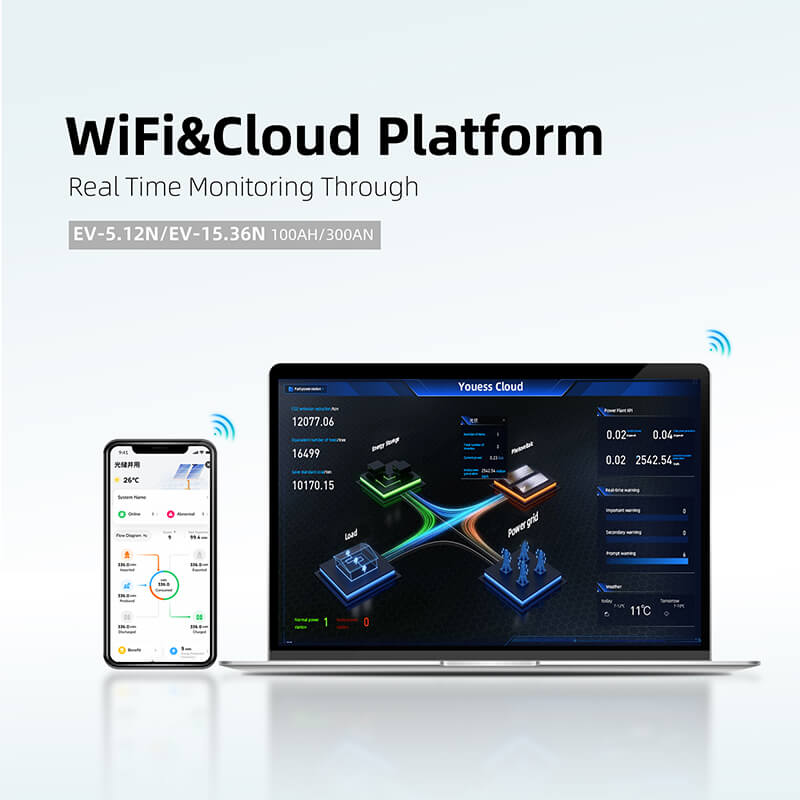
Real-time data monitoring (voltage, current, temperature, SOC, SOH)
Communication protocols such as CAN and RS485
Remote diagnostics via cloud or mobile apps
Advanced cell balancing for longer battery life
Dynamic charge and discharge optimization
Multi-battery parallel management
Firmware upgrade capability
Smart BMS systems are now widely used in:
Residential solar battery storage
Commercial and industrial ESS
Microgrid and virtual power plant projects
Why Smart BMS Is Becoming Essential in 2026
1. Solar + Storage Systems Are More Complex
Modern energy systems include:
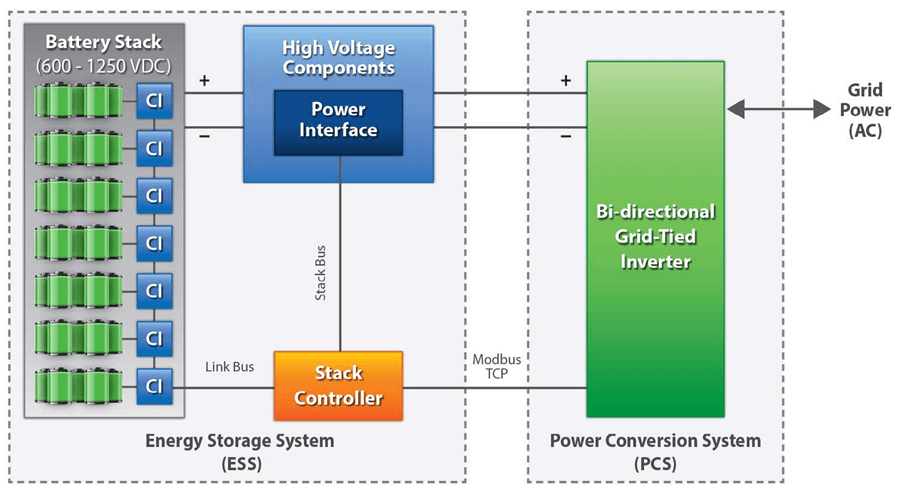
Hybrid inverters、Multiple battery clusters、Time-of-use energy strategies、Grid interaction
Smart BMS enables seamless system coordination, reducing commissioning time for installers.
2. Energy Cost Optimization Is a Priority
Smart BMS can help optimize:
Peak shaving strategies
Battery charging schedules
Solar self-consumption rates
This leads to higher return on investment (ROI) for both homeowners and businesses.
3. Remote Monitoring Reduces Maintenance Costs
For distributors and EPC companies managing multiple projects, remote monitoring allows:
Early fault detection
Reduced on-site service visits
Faster warranty response
Improved customer satisfaction
4. Longer Battery Lifespan
Advanced balancing and predictive analytics help:
Prevent deep degradation
Maintain stable performance
Extend usable battery cycles
This is particularly important for commercial energy storage projects where lifecycle cost is critical.
When Is Traditional BMS Still Acceptable?
Traditional systems may still be suitable for:
Small off-grid backup setups
Temporary energy storage
Budget-sensitive installations
Low cycling applications
However, as energy storage becomes a core infrastructure investment, most modern solar projects are transitioning toward smart battery platforms.
Final Thoughts
The shift from Traditional BMS to Smart BMS reflects the broader transformation of the energy storage industry toward intelligent, connected, and scalable power systems.
For installers, choosing smart battery technology can significantly reduce operational challenges.
For end users, it ensures greater safety, better performance, and stronger long-term savings.
As solar energy adoption accelerates worldwide, Smart BMS will continue to play a crucial role in shaping the future of battery energy storage systems.

 EN
EN
 FR
FR
 ES
ES
 AR
AR
 TL
TL
 MY
MY